
Desk And Chair Height Calculator
Based on averages for your stature, using ANSUR II data
Sitting Desk
—
Floor to Desk Top
Chair Height
—
Floor to Seat Top
—
Seat-to-Desk Clearance
What Is The Ideal Sitting Desk Height
At or slightly below your elbow level while sitting is the optimal ergonomic desk height. The Canadian Centre for Occupational Health and Safety recommends a 90 to 110-degree elbow bend. This calculator is specifically engineered to find that exact sweet spot for your body.
How The Calculator Works
We draw on data from 6,068 participants in the U.S. Army Anthropometric Survey (ANSUR II), which is one of the largest collections of real human body measurements in existence.
Because sitting elbow height is measured from the seat rather than the floor, the correct desk height depends on your chair height. To calculate both, the tool first estimates your popliteal height (the distance from the floor to your knee crease), and adds 3 to 4 cm to account for seat compression and put your hips above the knees. Then the average seated elbow height for your stature is stacked.
Formulas used (h = stature in cm)
Measurement | Male | Female |
|---|---|---|
Chair height | 0.24h + 3.9 | 0.235h + 3.0 |
Sitting elbow height | 0.0733h + 11.63 | 0.0471h + 15.57 |
Sitting desk height | Chair height + Sitting elbow height | |
Although women have proportionally longer torsos, men’s broader shoulders and arm proportions cause their elbows to rest slightly higher above the seat.
For a complete breakdown of our regression models, view our full data tables for elbow height by stature.
Desk Height Range Calculations
The Top Bound (90°): The absolute highest your desk should be. This is literally your elbow height relative to the floor plus or minus the thickness of the keyboard.
The Bottom Bound (110°): Using biomechanical trigonometry, we estimate your forearm length (roughly 15% of your total height) and calculate the precise vertical drop required to open your elbow angle by 20 degrees. The lowest your desk should be.
Why Keyboard and Shoe Height Matter
Both have an impact on your furniture height and sitting posture:
- To prevent shoulder shrugging, the calculator automatically subtracts your keyboard’s thickness from the total recommended desk height. A thicker keyboard can increase wrist extension, but proper desk height minimizes the strain by allowing your hands to easily hover slightly above the keys.
- Wearing heels or thick-soled shoes raises your knees, which shifts your ideal chair and desk height.
Tips for Non-Adjustable Furniture
Use the “Set Custom Height” toggles in the calculator to get tips exact accessory recommendations.
For a high desk
A keyboard tray is the most effective fix, as it drops the typing surface independently, letting you keep the chair at the right height. If that is not an option because of thigh clearance for example, raise the chair and add a footrest.
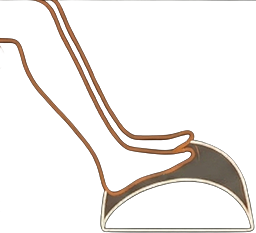
The calculator will suggest the exact height needed when you select enter your desk height.
If the desk is too low
Place risers or dense rubber furniture feet under the desk legs. For a DIY option hardwood blocks cut to size work well too.
If the chair won’t go high enough
The reliable long-term solution is installing a taller gas cylinder or purchasing a new chair. For a quick fix, a high-density seat cushion or a folded blanket provide a small raise. Just keep in mind that doing this possibly shifts your alignment with the chair’s built-in lumbar support and armrest height.
How to verify your results
These chair and desk heights are highly accurate, but they are still averages. Here is how to verify the results for your body through using the correct posture:
Step 1: Chair Test
At the correct height, your feet should rest flat on the floor, your thighs should be roughly parallel to the ground, and your knees should be bent at 90 to 110 degrees, slightly below your hips.
Bonus Test: You should be able to slide two or three fingers easily between the back of your thighs and the front edge of the seat.
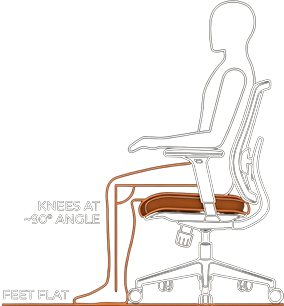
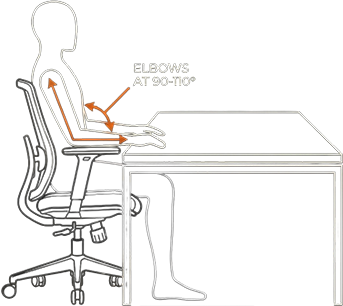
Step 2: Desk Height
Sit up straight, relax your shoulders, and let your arms hang loosely at your sides. Bend your elbows to 90–110 degrees. Your desk surface or the keyboard’s “home row” keys (ASDF) should sit exactly at or just below your hands.
Need to find out your ideal standing desk height? Please visit our dedicated calculator.
Why Proper Desk Height Matters
While sitting might feel like resting, an unoptimized gaming or work table height forces your muscles to work constantly, creating a load that builds quietly throughout the day.
The body compensates by hunching, shrugging or flaring out the elbows, etc. Over hours, these postures become unnatural and can lead to stiffness and tension in the neck, shoulders, and upper back.
Ensuring your chair and computer desk are at an ergonomic height minimizes the strain from sedentary work.
Share This Chart
Assumptions: Barefoot (0″ shoes), low-profile keyboard (0.6″ / 1.5cm), averaged male/female proportions.
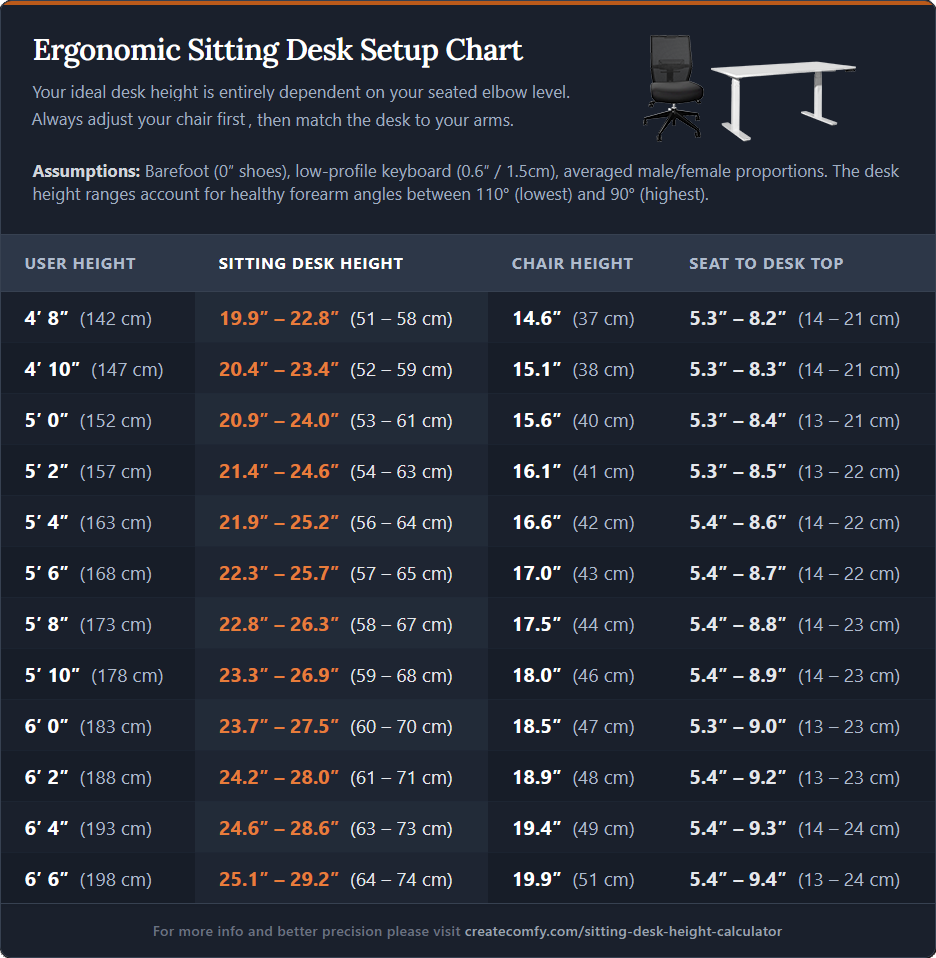
Body Height | Sitting Desk Height | Chair Height | Seat to Desk Top |
|---|---|---|---|
147 cm | 52 – 59 cm | ~ 38 cm | 13.4 – 21.0 cm |
150 cm | 53 – 60 cm | ~ 39 cm | 13.4 – 21.1 cm |
152 cm | 53 – 61 cm | ~ 40 cm | 13.5 – 21.2 cm |
155 cm | 54 – 62 cm | ~ 40 cm | 13.5 – 21.4 cm |
157 cm | 54 – 62 cm | ~ 41 cm | 13.5 – 21.6 cm |
160 cm | 55 – 63 cm | ~ 42 cm | 13.5 – 21.7 cm |
163 cm | 56 – 64 cm | ~ 42 cm | 13.6 – 21.9 cm |
165 cm | 56 – 65 cm | ~ 43 cm | 13.6 – 22.0 cm |
168 cm | 57 – 66 cm | ~ 43 cm | 13.6 – 22.2 cm |
170 cm | 57 – 66 cm | ~ 44 cm | 13.6 – 22.3 cm |
173 cm | 58 – 67 cm | ~ 45 cm | 13.6 – 22.5 cm |
175 cm | 59 – 68 cm | ~ 45 cm | 13.7 – 22.6 cm |
178 cm | 59 – 69 cm | ~ 46 cm | 13.7 – 22.8 cm |
180 cm | 60 – 69 cm | ~ 46 cm | 13.7 – 22.9 cm |
183 cm | 61 – 70 cm | ~ 47 cm | 13.7 – 23.1 cm |
185 cm | 61 – 71 cm | ~ 47 cm | 13.7 – 23.2 cm |
188 cm | 62 – 72 cm | ~ 48 cm | 13.8 – 23.4 cm |
Body Height | Sitting Desk Height | Chair Height | Seat to Desk Top |
|---|---|---|---|
4’10” | 20.4″ – 23.4″ | ~ 15.1″ | 5.3″ – 8.3″ |
4’11” | 20.7″ – 23.7″ | ~ 15.4″ | 5.3″ – 8.3″ |
5’0″ | 20.9″ – 24.0″ | ~ 15.6″ | 5.3″ – 8.4″ |
5’1″ | 21.2″ – 24.3″ | ~ 15.8″ | 5.3″ – 8.4″ |
5’2″ | 21.4″ – 24.6″ | ~ 16.1″ | 5.3″ – 8.5″ |
5’3″ | 21.6″ – 24.9″ | ~ 16.3″ | 5.3″ – 8.6″ |
5’4″ | 21.9″ – 25.2″ | ~ 16.6″ | 5.3″ – 8.6″ |
5’5″ | 22.1″ – 25.5″ | ~ 16.8″ | 5.3″ – 8.7″ |
5’6″ | 22.4″ – 25.8″ | ~ 17.0″ | 5.4″ – 8.7″ |
5’7″ | 22.6″ – 26.1″ | ~ 17.3″ | 5.4″ – 8.8″ |
5’8″ | 22.9″ – 26.4″ | ~ 17.5″ | 5.4″ – 8.9″ |
5’9″ | 23.1″ – 26.7″ | ~ 17.7″ | 5.4″ – 8.9″ |
5’10” | 23.4″ – 27.0″ | ~ 18.0″ | 5.4″ – 9.0″ |
5’11” | 23.6″ – 27.3″ | ~ 18.2″ | 5.4″ – 9.0″ |
6’0″ | 23.9″ – 27.6″ | ~ 18.5″ | 5.4″ – 9.1″ |
6’1″ | 24.1″ – 27.9″ | ~ 18.7″ | 5.4″ – 9.2″ |
6’2″ | 24.4″ – 28.2″ | ~ 18.9″ | 5.4″ – 9.2″ |
Note: These estimates are based on a typical, able-bodied adult. Individual conditions may warrant professional ergonomic assessment.
Frequently Asked Questions
Thank you for using the sitting desk and chair height calculator! My goal was to make finding your height more visual and intuitive, rather than just giving you numbers on a page. I hope it helps you build a setup that feels natural and sustainable! If you found this useful, please share it 🔗. Have questions or feedback? Leave a comment or email me at georgi@createcomfy.com.


The idea of adjusting the chair based on thigh parallelism is spot on. I didn’t realize how much desk height plays into it, though!
Thank you so much for this lovely informative presentation


Leave a Reply