A chair that is off in height or proportions can quietly cause poor posture and fatigue over time. This guide walks you through how to measure a chair and its dimensions accurately, especially how to measure office chair height, so you can better match them to your body and desk setup.
What You Will Need
- A tape measure or a ruler.
- A flat, hard floor surface
These basic tools are sufficient for most people learning how to measure chair dimensions at home, even without specialized testing equipment.
Pro Tip: For professional-grade accuracy, manufacturers use a Chair Measurement Device (CMD). This tool simulates the weight of a person to get the “compressed” height and more. While you likely don’t have a CMD at home, understanding how it works helps you read spec sheets like a pro.
How to Measure Chair Height
Chair height almost always refers to seat height, which is the vertical distance to the top of the cushion where you sit.
How to Measure Seat Height
Make sure the chair is on flat ground and not tilted. There are two ways to measure seat height:
- From the floor to the center of the seat cushion, where your hips rest, or
- From the floor to the top of the seat cushion at its front edge.

Measuring at the center where your hips rest is often more practically relevant for users adjusting their chair. This approach aligns better with popliteal height and ergonomic setup guides, which focus on posture, not product specs.
The “front edge” method sometimes used by furniture manufacturers can be misleading because it’s often the least accurate place to measure if you want to know how a chair actually feels. The front lip is frequently designed with a “waterfall” curve or a raised bolster, which doesn’t represent the functional height of the seat.
Height Adjustment Range
- Measure from the floor to the lowest and highest seat height positions
To comfortably fit users between the 5th and 95th percentile, a chair should provide a seat height range from 346 mm (13.6 in.) to 512 mm (20.2 in.).
Within this range, most users can sit with their feet flat on the floor, and without undue pressure on the underside of the thighs, supporting proper leg circulation and alignment with the desk.
Overall Office Chair Height
Overall chair height is the total vertical dimension of the chair. This is a crucial step in measuring office chair height if you need to fit it under shelving.
How to measure:
- Place the chair on a flat, level floor.
- Set the chair to its maximum height position.
- Measure vertically from the floor to the highest point of the chair, whether that is the top of the backrest, headrest, or any other fixed component.

If the chair has an adjustable headrest, measure with it set to its highest position.
This is value doesn’t reflect comfort. Two chairs with the same total size can feel very different if their seat heights, backrest shapes, or cushion thicknesses differ.
How To Measure Seat Depth
Adequate seat depth supports the thighs and allows the user to sit back far enough to use the lower portion of the backrest without creating pressure on the back of the knees.
- Using a tape measure, measure horizontally from the front of the seat pan to the point where the seat meets the backrest.
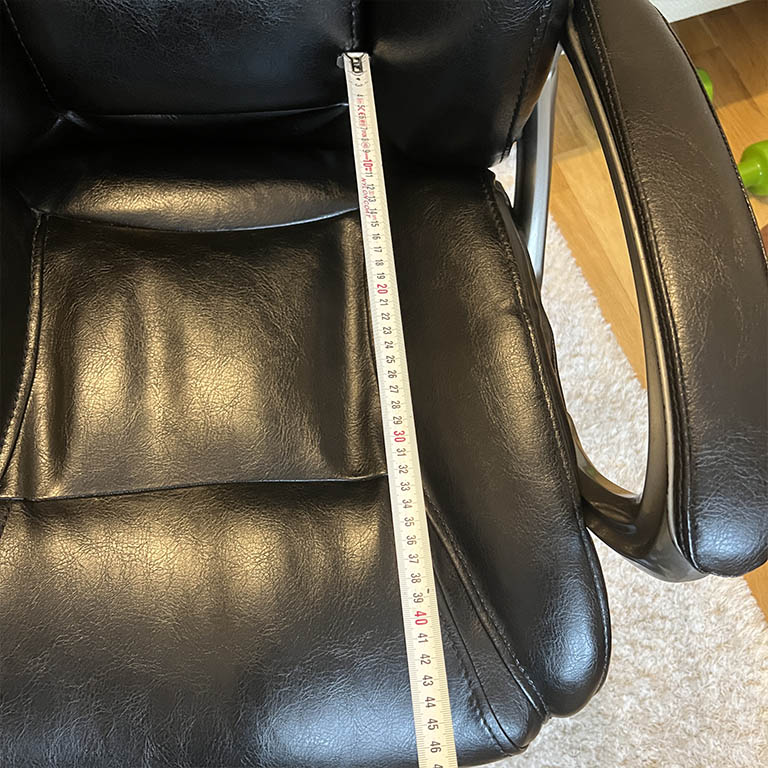
Seat depth fits properly when it is shorter than the user’s buttock–popliteal length. Work chairs designed to accommodate a specified user can achieve fit by either adjustability or by using different sizes of the seat pan.
In practice, an optimal seat depth lets you sit back against the backrest while leaving a small gap (about 3 fingers’ width or 2 inches) between the seat edge and the back of your knees.
Why it matters:
- Too deep → pressure behind knees
- Too shallow → poor thigh support
How To Measure Seat Width
Seat width is the space from side to side across the seat and can be measured in two ways, depending on what you need:
- Usable seat width: the narrowest sitting area between where your hips would rest, near the back of the seat.
- Total seat width: the full width of the seat cushion, including flared or padded sides.
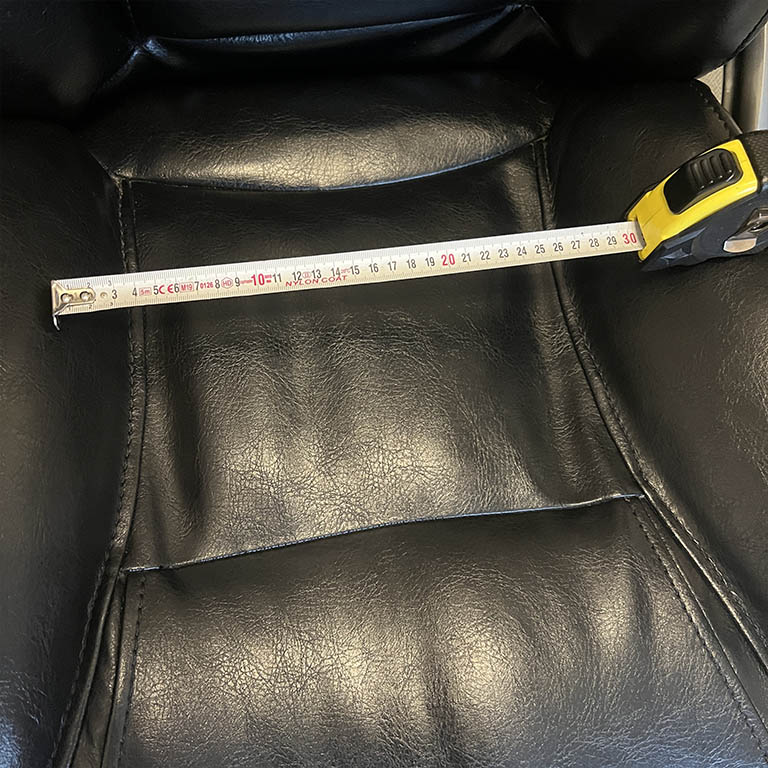
Seat width fits properly when it is wider than the user’s seated hip breadth. You want enough space to sit without feeling squeezed, but not so much that the armrests become awkward to use. As a practical check, about 1 inch (2–3 cm) of clearance on each side of your hips is a good target.
Backrest Height
Backrest height describes how tall the chair’s back support is. It affects how much of your back is supported, especially in the lumbar and upper-back regions.
How to measure:
- Set the chair to a neutral, upright position.
- Measure vertically from the seat’s center where you sit to the top edge of the backrest.
Do not include any headrest in this measurement. For chairs with adjustable backrest height, measure at both the lowest and highest positions to understand the adjustment range.
If you lean back often or work long hours, taller back support is usually better.
Armrests
Armrests support the forearms and help reduce load on the shoulders and upper back. Their height and spacing affect comfort, posture, and how close you can sit at a desk. Knowing how to measure office chair armrests helps understand how to prevent common ergonomic issues.
Armrest Height
This is how high the arm support is when you are seated.
- Measure vertically from the seat’s center to the top surface of the armrest.
Proper height allows your arms to rest comfortably without lifting your shoulders or forcing your elbows down.
Armrest Spacing
Spacing is the horizontal distance between the inner edges of the armrests. It determines how much room your torso and arms have while seated.
- Measure horizontally between the inner edges of the armrest pads.
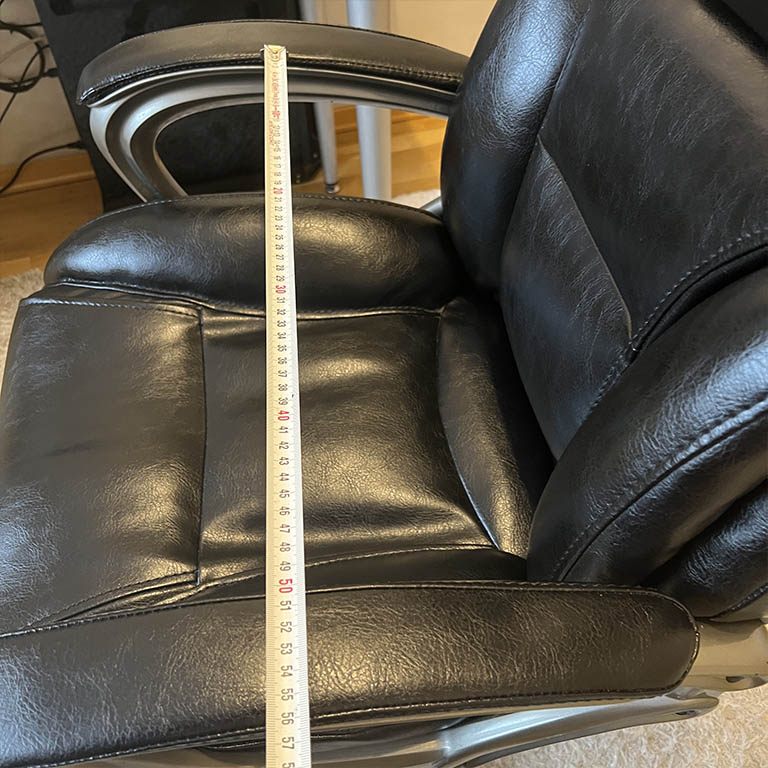
The spacing should allow your arms to rest naturally without squeezing your torso or forcing your elbows outward.
Chair Base Width
The chair base is the part of the chair that contacts the floor, usually a five-star base with casters. Its size determines how much floor space the chair occupies and how stable it feels.
How to measure:
- Measure horizontally from the outer edge of one base leg to the outer edge of the opposite leg.
- If the base is not perfectly circular, measure the widest point of the base.
Why it matters:
A wider base generally provides more stability, especially for taller chairs or users who lean back often.
A larger footprint may require more floor space and may not fit well on smaller chair mats or in narrow desk setups.
Chair Wheel Size
Chair wheels, also called casters, allow the chair to roll and pivot on the floor. Their size affects how easily the chair moves, how stable it feels, and slightly influences the overall chair height.
How to measure:
- Measure the diameter of a single wheel from top to bottom, excluding the stem or mounting hardware.
Why it matters:
Larger wheels roll more easily over carpet, rugs, and uneven surfaces.
Smaller wheels offer better control on hard floors and keep the chair slightly lower.
Standard Office Chair Dimensions
After measuring individual parts of a chair, it helps to know how those numbers compare to common office chair dimensions. The ranges below show typical measurements found across adjustable office chairs, including wider and high-back designs.
| Dimension | Typical Range | Notes |
|---|---|---|
| Seat Height | 16–21 in (40–53 cm) | Floor to seat surface |
| Seat Depth | 16–18 in (40–46 cm) | Adjustable seats may extend further |
| Seat Width | 18–21 in (46–53 cm) | Usable sitting width, not outer cushion width |
| Backrest Height | 18–24 in (46–61 cm) | Does not include headrests |
| Armrest Height | 7–11 in (18–28 cm) above seat | Adjustable armrests are underrated |
| Armrest Spacing | 17–21 in (43–53 cm) inside | Depends on chair width |
| Chair Base Width | 24–28 in (61–71 cm) | Measured leg tip to leg tip |
| Wheel Size | 2–2.5 in (5–6.5 cm) | Larger wheels roll better on carpet |
Standard office chairs are built to fit a broad population, typically spanning the 5th to 95th percentile. Custom or specialty chairs exist, but understanding these baseline dimensions helps explain where standard designs start to break down and how important adjustability is. It can be easy to adjust a chair that is too big to be lower, but if the armrests also aren’t adjustable, they won’t be able to go under the desk. Actual comfort depends on body proportions and adjustment range.
Chair Fit and Body Alignment
Start by using our chair height calculator to get a personalized recommendation based on your height, shoe thickness, and gender. It also considers your desk height and suggests accessories like footrests if needed.
The result gives you a solid starting point. Set your chair to that height, then fine-tune using the guidelines below to ensure true fit.
🦶 Seat Height and Leg Position
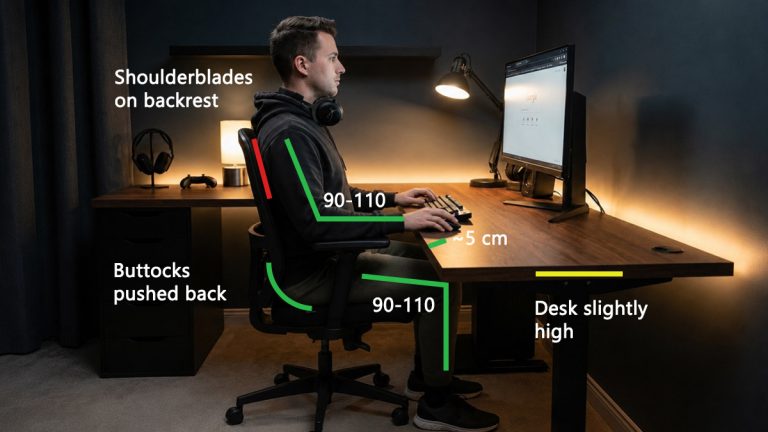
Once seated, your feet should rest flat on the floor or a footrest. Your knees should be slightly lower than your hips, with roughly a 90° to 110° bend at the knees. If your feet dangle, raise the floor (not lower the chair) using a footrest. If your knees are higher than your hips, raise the chair and adjust desk setup if needed.
🪑 Seat Depth and Thigh Support
Your hips should be positioned all the way back in the seat. Check for 2–3 fingers of space between the seat edge and the back of your knees. If the seat pan is too long or too short, adjust the seat depth or use a cushion to reduce pressure.
💪 Armrests and Shoulder Support
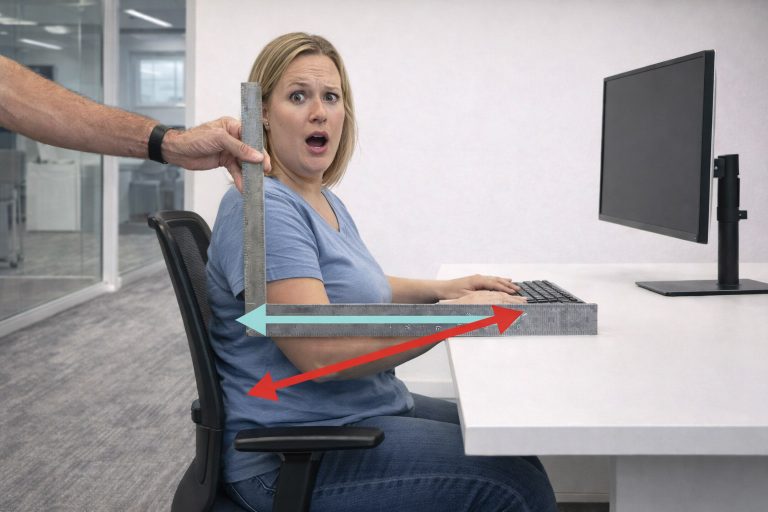
Arms should rest comfortably on the armrests or desk surface, with elbows bent about 90°. If your shoulders feel hunched or unsupported, adjust the armrest height or width. Armrests should not block you from pulling in close to your desk, adjust or remove them if needed.
🦴 Backrest and Lumbar Contact
The chair’s lumbar support should align with the natural inward curve of your lower back. If it’s adjustable, raise or lower it until you feel even support across the lower spine. Too high or too low and it may cause slouching or discomfort.
⚠️ Common Chair Measuring Mistakes
Even after learning how to measure a chair, small setup mistakes can lead to misleading numbers.
Measuring on uneven ground
If the chair is on a rug, sloped floor, or mat with deep wheels, the tape measure may start higher or lower than expected. Always place the chair on a hard, flat surface.
Measuring to the wrong part of the backrest
For backrest height, measure from the seat surface to the top of the backrest, not to the headrest unless specified. Don’t include cutouts or dips, measure to the true top edge.
Not setting the chair appropriately
If the chair is tilted, your measurement may be off. Decide whether you to want measure the chair’s maximum height or how you actually use it, then set the chair accordingly.
Measuring seat height at the wrong point
Many people use a tape measure to the front edge of the seat, because its the most convenient, but that spot is often sloped or raised. For better accuracy, measure to the top of the seat cushion where your hips rest. This might require calculating the difference between the two.
Ignoring seat compression
Real pros simulate seated pressure when measuring office chair components (per BIFMA standards), but for everyday use, it’s fine to measure with no one sitting. Just be consistent.