

Working from home is no longer a temporary solution or a workplace perk, it is a defining feature of the modern labor market. By 2025, remote and hybrid work have matured into stable.
What started as a slow shift in the early 2000s was dramatically accelerated by the pandemic, then refined through years of experimentation. Today, we finally have enough long-term research to move beyond opinions and look clearly at the benefits of working from home statistics reveal across productivity, finances, mental health, work–life balance, environmental impact, and job satisfaction.
The Rise and Stabilization of Remote Work
From Early Telecommuting to a Permanent Shift
Between 2005 and 2019, regular remote work increased by 216%, a pace more than eleven times faster than the rest of the workforce. Advances in cloud software, broadband internet, and digital collaboration tools laid the foundation well before the pandemic forced adoption at scale.
In 2019, however, working from home was still relatively rare. Only 5–7% of paid workdays in the United States were performed at home. That figure exploded to nearly 70% during the 2020 lockdowns, representing the largest workplace experiment in modern history.
What matters most is what happened next.
Where Remote Work Settled in 2025
After offices reopened, remote work didn’t disappear, it stabilized.
According to Gallup statistics, work-from-home rates leveled off at around 28% of all paid workdays, and by 2025 they remain steady at 26–28%. This is widely considered the “natural equilibrium” of remote work: not a temporary spike, but a structurally embedded model.
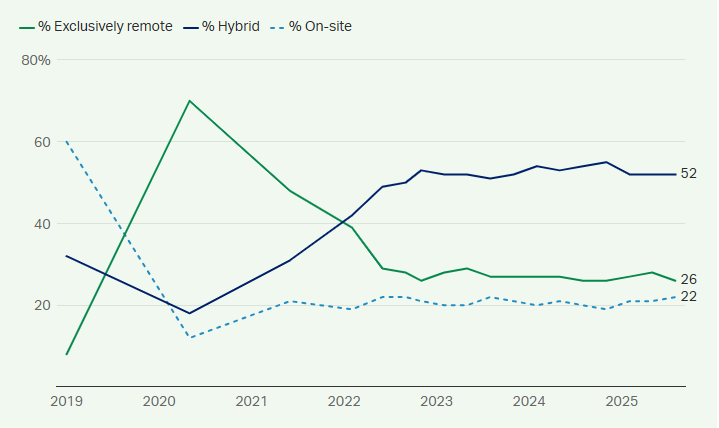
This stabilization follows a decades-long historical arc. While home-based work was actually higher in 1960 (4.7 million) before declining to a low in 1980 (2.2 million), the modern digital era revived the trend well before 2020.
Current U.S. remote-capable job arrangements (2025):
- Hybrid work: ~52%
- Fully remote: ~26%
- On-site: ~22%
This distribution reflects both operational realities and employee preferences.
What Workers Want
Even before the pandemic, surveys consistently showed a large “preference gap.” Roughly 80% of employees wanted to work from home at least some of the time, while far fewer were allowed to do so.
By 2025, preferences are clearer than ever:
- 60% prefer hybrid work
- 33% prefer fully remote
- Fewer than 10% want full-time office work
Hybrid work emerged as the dominant model because it balances flexibility with human connection, a theme that appears repeatedly across productivity and well-being research.
Does Working From Home Actually Work?
The Data Behind Remote Productivity
One of the earliest concerns about remote work was productivity. Would employees actually work—or would output decline without office supervision?
Years of data now give a clear answer.
A Bureau of Labor Statistics study found that every 1-percentage-point increase in remote work correlates with a 0.08-percentage-point rise in total factor productivity.
Total factor productivity measures how efficiently work gets done overall, not just how many hours people work. Importantly, it reflects changes across the entire economy rather than what any single company or individual experiences. Some sectors benefit more than others.
TFP captures improvements in areas like organization, technology, workflows, and management quality.
Why such a small number still matters
Total factor productivity typically moves very slowly. In developed economies, annual economy-wide TFP growth is often only around 0.5% to 1% in strong years.
If remote work adoption were to rise by 10 percentage points over time, the implied association would be roughly a 0.8 percentage point higher TFP level than would otherwise be expected.
In macroeconomic terms, that is a large effect.
Employee perception aligns with these findings. A national McKinsey survey reports that 83% of employees believe they work more efficiently and productively when remote.
Stanford’s Landmark Study Changed the Conversation
The most influential evidence came from a 2015 randomized controlled trial led by Stanford economist Nicholas Bloom. In a large Chinese travel agency, employees randomly assigned to work from home showed a 13% productivity increase.
That gain came from:
- 9% more minutes worked per shift (fewer breaks and sick days)
- 4% more output per minute due to quieter environments
When employees were later allowed to choose whether to work remotely or in the office, productivity gains nearly doubled to 22%. Choice, it turns out, is a powerful performance lever.
Why Remote Workers Often Get More Done
Several structural factors explain these gains:
- Commute elimination: Americans spend about 27 minutes each way commuting. Removing this adds hours of usable time each week.
- Fewer interruptions: Home offices are often quieter than open-plan offices.
- More deep work: Remote workers can structure their day around peak focus hours.
By 2025, 69% of managers agree that hybrid or remote work has made their teams more productive, an extraordinary reversal from early skepticism.
The Financial Benefits of Working From Home
One of the most tangible benefits of working from home is cost savings.
How Much Money Do Remote Workers Save?
Commuting and on-site work entail many expenses, all of which remote workers largely avoid. Estimates vary, but a reasonable figure is that a half-time remote worker can save on the order of $500 per month, and a full-time remote worker up to $1000 per month.
Today:
- Hybrid and remote workers save $6,000–$12,000 per year
- Full-time office workers face $55–$65 per day in work-related expenses
These savings come from reduced spending on fuel, public transit, parking, professional clothing, lunches, coffee, and other daily costs tied to office life.
Is Remote Work Basically a Raise?
Economists often describe remote work as a “hidden raise.”
As early as 2016, studies found employees were willing to give up 8% of their salary for the option to work from home. Remarkably, that figure is even higher in 2025.
In other words, workers still value flexibility as equivalent to a pay increase, before accounting for direct cost savings. This explains why many employees prioritize location flexibility even over salary increases.
Business Math
The financial case for remote and hybrid work is predicated on three primary pillars: real estate optimization, reduced turnover costs, and enhanced revenue growth through talent density. Organizations can realize an average saving of $11,000 per employee annually by implementing a hybrid model. These savings are driven largely by a 40% reduction in overhead expenses associated with physical real estate. In an environment where 85% of office floor space is still dedicated to individual workstations that often sit empty, the transition to smaller, more collaborative hubs represents a major opportunity for bottom-line improvement.
Beyond overhead, the impact on human capital is profound. The cost of replacing an employee is estimated to be between $10,000 and $30,000 for standard roles, but can escalate to 300% of an annual salary for specialized or executive positions. Firms that offer remote flexibility have documented a 26% reduction in turnover rates compared to those with on-site mandates. In specific sectors, such as the tech startup ecosystem, resignation rates fell by 33% following the adoption of a hybrid model.
Enterprise Financial Impact Metrics | Benefit Category | Estimated Value/Impact |
|---|---|---|
Annual Savings per Halftime Remote Worker | Overhead/Productivity | $11,000 |
Real Estate Cost Reduction | Operational Expense | 40% |
Revenue Growth Rate (Flexible vs. Non-Flexible) | Growth | 21% vs 5% |
Turnover Reduction | Retention | 26% |
Reduction in Unscheduled Absences | Absenteeism | 63% |
The correlation between flexibility and top-line growth is striking. Companies with fully flexible remote work policies experienced 21% industry-adjusted revenue growth over a three-year period, significantly outperforming the 5% growth seen in firms with exclusively on-site models. This disparity suggests that flexibility acts as a “productivity multiplier,” allowing firms to access a broader, more skilled talent pool without the constraints of local geography.
Work–Life Balance and Mental Health
Schedule Control
Flexibility is one of the most cited advantages of remote work. According to Gallup:
- 85% of fully remote workers report improved work–life balance
- 76% of hybrid workers say the same
Remote work allows people to align their schedules with their natural rhythms—working early mornings, late evenings, or in focused blocks rather than rigid 9-to-5 hours.
Commuting Time Reclaimed
Research from the National Bureau of Economic Research indicates that the average worker saves about 72 minutes per day by not commuting. That time doesn’t simply disappear:
- 40% of saved commute time is reinvested into work
- The rest goes to leisure, family, exercise, or personal projects
This reclaimed time is one of the most emotionally meaningful benefits of remote work, especially for parents, caregivers, and content creators juggling multiple responsibilities.
Clear Mental Health Upsides
Surveys consistently show that remote work supports mental well-being:
- 96% of workers say remote or hybrid work is best for their mental health
- Nearly 50% cite reduced stress as the top health benefit
- 93% of remote workers say working from home has a positive mental-health impact
Less commuting, more autonomy, and flexible routines all contribute to these outcomes.
The Engagement vs. Well-Being Tradeoff
At the same time, research reveals a nuanced “remote work paradox.”
Fully remote workers show:
- Highest engagement
- Lower overall life thriving
Psychological Well-being and Work Location (2025) | Fully Remote | Hybrid | On-Site (Non-Remote) |
|---|---|---|---|
% Engaged at Work | 31% | 23% | 19% |
% Thriving in Life Overall | 36% | 42% | 30% |
% Experiencing Daily Stress | 45% | 46% | 38% |
% Feeling Lonely “A Lot” (Gen Z) | 27% | N/A | N/A |
That’s according to the latest Gallup State of the Global Workplace report
Why? Digital fatigue, loneliness, and difficulty unplugging. Virtual meetings increased by 148% post-pandemic, contributing to emotional strain.
Why Hybrid Work Often Wins
Hybrid workers consistently score highest on overall well-being. They benefit from:
- Autonomy and flexibility
- Regular in-person social interaction
- Clearer boundaries between work and home
This is why hybrid work has become the dominant long-term model.
Job Satisfaction and Retention
Remote Work as a Retention Strategy
Remote work is now one of the most valued job benefits:
- 87% of job seekers consider flexibility critical
- Companies offering remote options see 26–33% lower turnover
Conversely, removing remote options carries real risk. Nearly 46% of remote-capable workers say they would consider leaving if forced back to the office full time.
Engagement and Loyalty
Autonomy, trust, and flexibility directly translate into engagement—and engagement fuels retention.
A May 2024 Gallup and Workhuman study of over 21,000 U.S. employees highlights a clear “engagement premium” for flexible work:
- Remote workers: 37% highly engaged
- Hybrid workers: 36% highly engaged
- On-site workers: 30% highly engaged
This provides a more optimistic view of the American workforce compared to the 31% / 23% / 19% figures in the Global State of the Workplace report, where engagement is generally lower across all regions.
Environmental and Social Impact of Remote Work
Lower Carbon Footprints
According to a study published in the journal PNAS, fully remote workers can have a carbon footprint up to 54% lower than their on-site counterparts. A 10% increase in remote work could reduce U.S. emissions by 192 million metric tons annually.
These reductions come primarily from fewer car commutes and less traffic congestion.
Frequency Matters:
- 1 remote day per week: ~2% emissions reduction
- 2–4 remote days per week: Up to ~29% reduction
- Fully remote: Maximum benefit
Consistent remote work, not occasional flexibility, drives meaningful sustainability gains.
Inclusion and Accessibility
Remote work has quietly become one of the most powerful inclusion tools in modern labor.
The civilian labor force of individuals with disabilities increased by more than 30% since the pandemic began, reaching a historic high in 2024. Remote work explains 68%–85% of this increase, as it removes the geographic and physical barriers of traditional offices.
Remote work expands the talent pool and creates opportunities.
The Big Picture: A Mature Remote Work Era
By 2025, the question is no longer whether remote work works. The data overwhelmingly says it does.
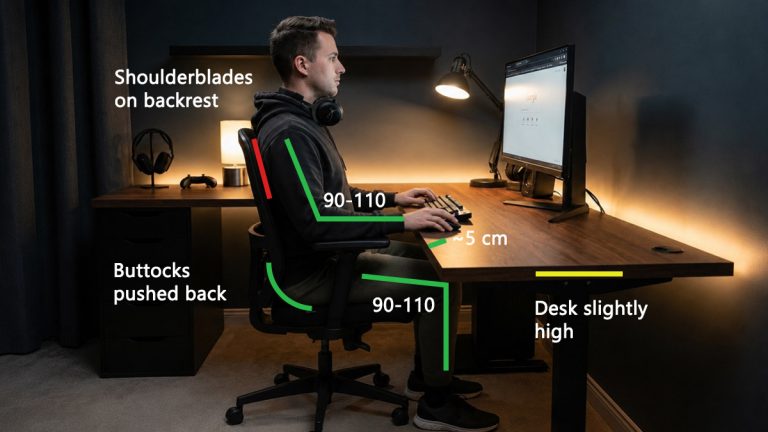
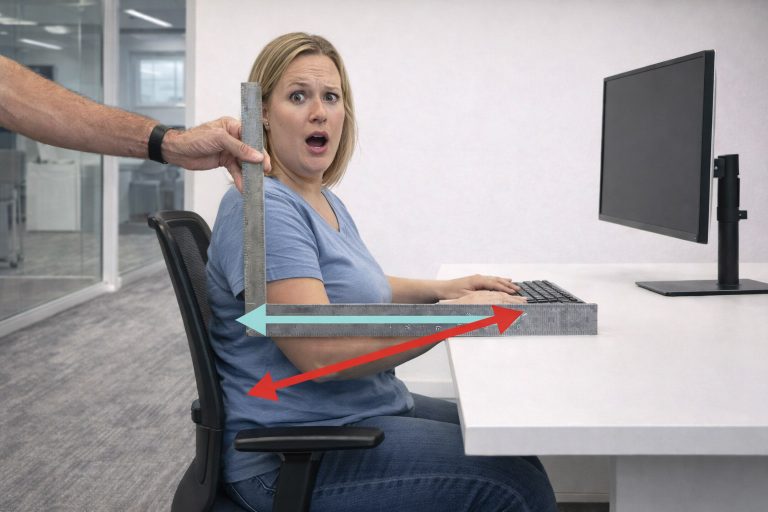
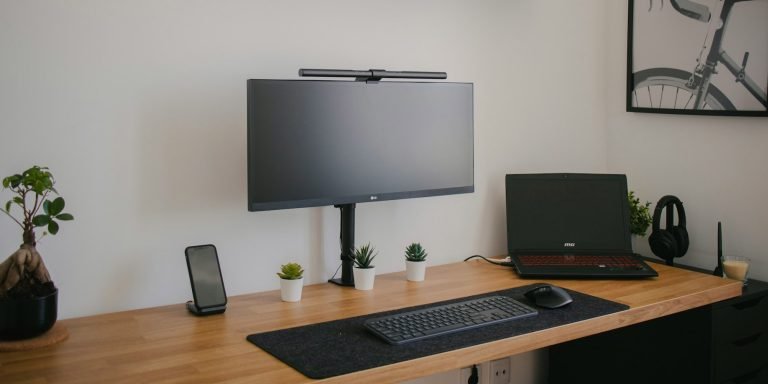
The real challenge now is refinement—designing systems that preserve productivity while addressing isolation, burnout, and digital overload. This is where thoughtful hybrid models, strong boundaries, and well-designed home workspaces become critical.
Taken together, the research paints a clear picture. The working from home statistics consistently show benefits in productivity, financial stability, mental health, environmental sustainability, and job satisfaction. For remote workers, freelancers, and content creators, working from home is not just convenient; it is transformative.
And as work continues to decouple from geography, the quality of the environment we work in matters more than ever.




It’s interesting how the post highlights the shift from remote work being a temporary solution to becoming a structural part of the labor market. The idea of a ‘natural equilibrium’ at around 26–28% really resonates—companies seem to have settled into what’s actually sustainable rather than what was reactionary during the pandemic. It’ll be fascinating to see how this equilibrium influences long-term workplace culture and employee expectations moving forward.