Satoshi’s appearances were limited to a cryptography mailing list, Bitcointalk forum discussions, private emails, and of course the Bitcoin whitepaper: no social media, nothing.
From these traces, we can infer his personality through his writing style, design choices, and the priorities he emphasized or dismissed. Let’s explore everyone’s favorite mysterious creator through MBTI and the deeper Jungian cognitive functions, using evidence.
Quick primer
What is MBTI?
The Myers–Briggs Type Indicator is a system that sorts people into 16 personality types based on how they think, decide, and interact with the world.
It classifies people on four dichotomies:
- I/E – Introvert / Extravert
- N/S – Intuitive / Sensing
- T/F – Thinking / Feeling
- J/P – Judging / Perceiving
The personalities read like ISTJ, ENFP, etc.
What are Jungian cognitive functions?
Carl Jung’s functions theory is the deeper framework behind MBTI. It explains why people think and decide the way they do, revealing the underlying mental processes like logical analysis, pattern recognition, gut decision-making, or attention to detail.
MBTI and Jung’s cognitive functions are related but distinct. Jung outlined eight functions like Thinking and Intuition, each expressed inwardly or outwardly. Myers and Briggs developed their system by adding the Judging/Perceiving dichotomy to create sixteen personality types.
The functions reveal how the mind actually works, offering deeper insight into behavior and motivation than the four-letter codes alone. Through them, we can gain a surprisingly detailed view of a person’s psyche.
Writing & lifestyle
Satoshi probably had a serious commitment to keeping privacy his whole life, not just during the Bitcoin phase and when we get to his type It’s going to click. Online he was posting in a clear, precise and formal style with no major spelling or grammar mistakes.
The main linguistic point of discussion is the inconsistent use of both British English and American English spellings, such as:
- Using the British spelling “favour” in the whitepaper
- Later using the American spelling “characterized” (instead of “characterised”)
Trail | Timezone Indication | Implied Location |
|---|---|---|
Code Commits | Primarily (UTC+1), with low activity during UK morning hours | United Kingdom |
Posting/Coding Gaps | Low/No activity during some Asian timezones (UTC+8) | Excludes Asia |
Whitepaper PDF Metadata | Mountain Time Zone (UTC-7) and (UTC-6) (with Daylight Savings) | Western United States |
Analysis of his activity hours shows he was most active from late afternoon until early morning UTC, a range consistent with both UK evenings and US working hours, making it difficult to pinpoint.
Satoshi’s personality clues
Satoshi Nakamoto may not even be one person, as nobody has ever met Nakamoto and some suspect it could be a group of developers. For our typing, we will assume it’s one person, and that their words and code reflect their mind.
Introvert (I) vs Extravert (E)
Introverts are people who focus on inner thoughts and ideas, while Extraverts who seek external stimulation. Satoshi was definitely introverted: he never made public appearances and ran Bitcoin operations behind the scenes. He even wrote in an email:
“I wish you wouldn’t keep talking about me as a mysterious shadowy figure, the press just turns that into a pirate currency angle. Maybe instead make it about the open source project and give more credit to your dev contributors; it helps motivate them.” [Late April 2011]
Introversion by Design?
Satoshi’s anonymity demanded solitude. Staying in the shadows wasn’t just a preference; it was necessary for Bitcoin to survive. But even without the mask, the numbers suggest he’d still be introverted.
General US Pop. | Bitcoiners | Software Engineers | |
Introversion | 50.7% | 73% | 57% |
In other words, Satoshi fit the mold: a man comfortable working alone, lost in long coding sessions, surfacing only when there was something worth saying.
Yes, anonymity forced him inward; but statistically he’d likely have been introverted anyway.
Intuitive (N) vs Sensing (S)
Intuitives trust patterns and future possibilities, while Sensors focus on concrete facts and immediate data. Satoshi’s vision was purely Intuitive: he built a new system of money from first principles, relying on cryptographic ideas. He talked about the big picture of trust, banks, and inflation rather than details of current banking operations. This reflects Intuitive thinking, spotting broad patterns like flaws in fiat money and designing a far-reaching solution. Satoshi remade the entire monetary system from the ground up.
Thinking (T) vs Feeling (F)
Thinkers prioritize logic and impersonal reasoning in decisions, while feelers prioritize harmony and personal values. Satoshi showed strong thinking preferences in his communication style. His writing was consistently analytical and technical, focused on logical arguments rather than emotional appeals.
His famous line, via the P2P Foundation blog post.
“The root problem with conventional currency is all the trust that’s required to make it work. The central bank must be trusted not to debase the currency, but the history of fiat currencies is full of breaches of that trust. Banks must be trusted to hold our money and transfer it electronically, but they lend it out in waves of credit bubbles with barely a fraction in reserve. We have to trust them with our privacy, trust them not to let identity thieves drain our accounts. Their massive overhead costs make micropayments impossible.” [February 2009]
When dismissing a skeptic on the Bitcointalk forum, he wrote:
“If you don’t believe me or don’t get it, I don’t have time to try to convince you, sorry.” [Late July 2010]
No beating around the bush or seeking emotional agreement.
Judging (J) vs Perceiving (P)
Judging types prefer structure, plans, and decisiveness, while perceivers prefer flexibility and spontaneity. Satoshi’s work suggests a Judging preference. He meticulously crafted Bitcoin’s code and protocol into a complete, self-contained system. Once it was live, he stopped contributing.
In his final email to developer Mike Hearn, he wrote:
“I had a few other things on my mind (as always). … I’ve moved on to other things. It’s in good hands with Gavin and everyone.” [April 2011]
This was a soft farewell and a handover of stewardship to Gavin Andresen and the developer community. Satoshi set a goal (create Bitcoin), executed it methodically, and then closed the chapter. A Perceiver might have continued iterating and adapting indefinitely; Satoshi’s decision to move on reflects decisiveness and completion.
Putting it together
The evidence is clear: Satoshi comes across as INTJ, an intensely private, vision-driven strategist. He worked alone (Introvert), focused on systems and possibilities (iNtuitive), made decisions through logical analysis (Thinking), and executed a methodical plan before disappearing (Judging).
These traits map perfectly onto the kind of mind that could create Bitcoin: a long-term thinker focused on impact over recognition.
Before we dive deeper let’s see what others think.
Crowd opinion on Satoshi’s type
On Personality Database, a website where users weigh in their opinion on famous people and characters, Satoshi’s MBTI results are strikingly consistent across the first three letters, but shaky on the final one.
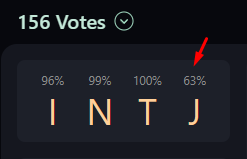
The debate is whether he is more Judging or Perceiving
Here is how probable each type is:
- INTJ = 96% × 99% × 100% × 63% ≈ 60% chance
- Strategic, big-picture architect, the mastermind who builds systems to outlast himself, which aligns with how Bitcoin was designed.
- INTP = 96% × 99% × 100% × 37% ≈ 35% chance
- Independent problem-solver, more experimental and theoretical, which also resonates with Satoshi and cryptography discussions.
Satoshi is almost certainly an INT type, with the others adding up to only 5%.
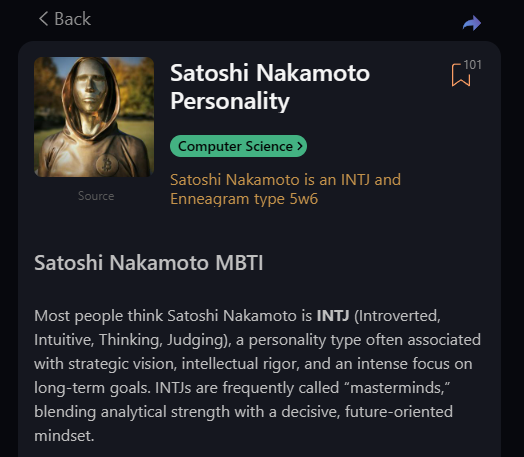
Why not INTP (or others)?
INTPs are also introverted thinkers, fond of theory and abstraction. They’re called “Logicians” for a reason. INTPs are curious and reserved (and indeed, in a Twitter poll, 22% of Bitcoiners were INTPs), so on the surface it’s plausible. However, INTPs tend to be more improvisational and less driven to implement finished systems. They happily tinker and explore an idea from many angles. Satoshi, on the other hand, was unusually single-minded and brought Bitcoin to completion as a working product. He even anticipated every question, as seen in the exhaustive FAQ and forum comments. Those Te-driven traits of control and closure feel more INTJ-like. INTPs also love knowledge for its own sake, while Satoshi seemed almost obsessively goal-oriented, focused on this one revolution.
Other NT types like ENTJ or ENTP can be ruled out. Satoshi never positioned himself as a frontman or chatter; he never displayed any extraverted side at all.
Synthesizing it all, Satoshi’s mind appears to be an Introverted, Intuitive, Thinking powerhouse, and almost certainly Judging rather than Perceiving. He’s the archetypal “Mastermind,” the one who conceives a grand future, lays down a systematic plan, and executes it with ruthless logic. To quote Tales of Satoshi, he “set Bitcoin free,” knowing it could live beyond him, that’s a very Ni-Te move.
The most likely Satoshi personality type
Now we’re certain about Satoshi’s personality type “INTJ”, this type’s dominant function, Introverted Intuition (Ni), makes them fixated on long-term outcomes. They live in tomorrow more than today. That’s why Satoshi built a system that could survive decades of attacks, economic shifts, and political hostility. Bitcoin wasn’t a hobby; it was a vision carried through with relentless focus. You can almost picture Satoshi at his desk, refining every line of code while already seeing the monetary system years ahead.
Most observers, including the Tales of Satoshi analysis settle on INTJ as the best fit. We’ll dive deeper at what that means in a moment, but first let’s look at the community he left.
Bitcoiners resemble Satoshi
There’s something strangely wholesome about polls of the Bitcoin community showing that INTJs and INTPs are by far the most common types, representing up to 51% of Bitcoiners.
Bitcoin was adopted by minds most like the creator and continues to propagate through idea‑driven, high‑autonomy thinkers.
This is amazing, knowing these personalities are among the rarest.
The J/P balance in the community
Bitcoiners are unusually balanced between Judging (51%) and Perceiving (49%). The general population leans more heavily toward Judging.
This balance means the community contains both structured builders (Js) and adaptive explorers (Ps).
Who are the INTJs
For the next sections diving deeper into Satoshi Nakamoto’s personality type we’re going to rely on an expert in Jungian analytical theory – CS Joseph, and his extensive material on this personality.
INTJs rarely reveal even their real name online and often test others’ loyalty before trusting them. They are intensely private, long-term strategic thinkers and one of the rarest minds out there. “They’re see-it-through types,” he says, people who might hesitate to start but once committed will not stop until it’s done. Their dominant function, Introverted Intuition (Ni), is pure willpower. INTJs literally will themselves through obstacles, and they’re wanty, they desire things.
Satoshi could become an expert in things quick, and that’s because they really spend the time and effort. Their laziness is basically because they either lack a cause they’re going for or they lack a moral reason for what it is. We can only imagine how passionate and dedicated he was to build a new monetary system in just a couple of years.
Underneath that productivity, though, sits a quiet self-doubt. Their Ti Critic function constantly questions whether their reasoning is sound. It whispers that their logic might be flawed, that they’ve missed something, that they’re not as competent as they appear. This creates a kind of intellectual insecurity beneath their confident exterior. Joseph says INTJs, especially younger ones, can walk around believing they’re stupid even when they’re far above average in understanding.
That inner doubt is exactly what pushes them toward their Te Parent, the external validation of logic through data, research, and sources.
Did Paranoia birth Bitcoin?
INTJs have trust as a major issue in relationships: they constantly question others’ intentions and feel betrayed by even minor slights.
They don’t trust anybody lightly. Loyalty must be proven, tested, and reaffirmed. One perceived betrayal, real or imagined, and the bridge burns instantly. When pushed too far, their Si demon erupts. The INTJ becomes, in Joseph’s words, “judge, jury, and executioner.” Once someone is written off, they’re gone, dead in the INTJ’s mind.
They worry about the intentions of other people so much that they are the most paranoid of all types.
After understanding this, I think fiat and the old system had it coming. They weren’t transparent, they didn’t build trust, and all decisions were made by shady, powerful people behind closed doors. All public announcements and relations were pro forma. It’s amazing how early Satoshi realized they were probably playing a trick, long before the majority of people knew what inflation or Bretton Woods was.
He was not the only one; there were many attempts to create a free currency even earlier, but he was the one who made it work.
Insecure about giving you a bad experience
If Satoshi was an INTJ, he would also be insecure about giving people a bad experience because of Se Inferior. That could include a presentation they give in class, intimacy, how they sound, how they come off, or how they look. They’re literally afraid of giving someone a bad experience and are constantly trying to manage the expectations and thinking of other people. This is performance anxiety, and because of their Fe Trickster, that social awkwardness of “I don’t know how everybody around me feels, I don’t know if anyone actually likes me,” it becomes worse. “If they don’t like me, I don’t know if they’re also going to like the experience…”
Until now, like many, I thought that Satoshi chose to be private mainly for security. That is a big part, but he also didn’t want to bring himself in and possibly ruin the experience he was giving us. It made him less anxious. And that was 100 percent the right choice. Can you imagine if Satoshi was a bloke from Birmingham living next to a pizzeria, with blue hair, posting tiktoks? Experience ruined.
Anonymity creates neutrality, which is important for something everyone should use. No skin color, no pimples to be worried about, no voice or nationality to divide people. He leveled the playing field and made it a strength. People wondering who he is boosted the press and made it more interesting.
They take their status and reputation seriously
They collect credentials (degrees, titles, certifications) to prove their competence, partly to quell their own insecurities. As CS Joseph explains, they “try to get their PhDs and MBAs… because it’s proof I know something,” ensuring others take them seriously.
Satoshi didn’t claim expertise or credentials, but he always used a formal tone. The Bitcoin white paper and early software demonstrate deep expertise in computer science and cryptography without needing to make up credentials or use real ones that could lead back to him or create bias.
The would be personality type of Satoshi also really cares about credit. Credit is not the same thing as recognition; that’s social recognition. Credit is like having their name listed in the credits after a production. Having their name placed somewhere is a very Te thing; it’s all about reputation.
If you do not thank them for giving you a good experience or at least show them in some way that they are giving you a good experience, or if you make fun of how they sound or look, they will hate you and cut you off completely.
In that sense, Satoshi got the biggest thank you by the community naming the smallest unit of Bitcoin a Satoshi.
Sidenote: Some people claim Satoshi is a woman, to me it sounds like a male name, but let’s look at the stats. According to one source, INTJs make up approximately 2.1% to 2.6% of the general population, with about 3.3% of men and only 0.8% of women having this personality type. It looks four times more likely Satoshi was a man.
Conclusion
This brings us to an end for now, friends. If you’d like to add something, feel free to write a comment or shoot an email. Thank you, Satoshi, you’re probably somewhere out there, being the smuggest, proudest INTJ.
Bitcoin’s creator is better left hidden. CS Joseph says never ever ask an INTJ about their past or go after it, they really hate it. So please forgive us for being so interested in you. You set us free.